

Sentimental Value
On gifting a DVD of Irreversible to a child...

Among all the stylistic grandeur of The Worst Person in the World, there’s this key sequence I always think about.
Long since they broke up, Julie and Aksel reunite after she learns he’d been diagnosed with pancreatic cancer. The whole film sort of stops for a sequence that shows Aksel’s decline. Nothing else exists in this stretch, it’s just the two of them. And I think of this scene all the time.
After talking about rewatching Lynch and The Godfather Part II and Dog Day Afternoon, Aksel monologues a bit (apologies for the length):
Sometimes I listen to music I haven’t heard before. But it’s old as well. Music I didn’t know about but from when I grew up. It felt as though I’d already given up.
I grew up in an age without internet and mobile phones […] I sound like an old fart but I think about it a lot. The world that I knew has disappeared.
For me, it was all about going to stores. Record stores. I’d take the tram to Voices record store in Grünerløkka. Leaf through used comics at Pretty Price. I can close my eyes and see aisles at Video Nova in Majorstua.
I grew up in a time when culture was passed along through objects. They were interesting because we could live among them. We could pick them up. Hold them in our hands. Compare them […] That’s all I have. I spent my life doing that. Collecting all that stuff, comics, books. And I just continued even when it stopped giving me the powerful emotions I felt in my early twenties. I continued anyway.
And now it’s all I have left. Knowledge and memories of stupid, futile things nobody cares about.
[…]
In recent years, I reached a point in life when suddenly it just happened. When I began to worship what had been. And now I have nothing else. I have no future. I can only look back. It’s not even nostalgia. It’s fear of death. It has nothing to do with art.
Joachim Trier, as he demonstrates in Worst Person and at points in Sentimental Value, has an uncanny talent at digging down into this deep, millennial-coded angst. When Gustav (Stellan Skarsgård) attends his grandson’s birthday, having been largely absent, he gifts the child a stack of DVDs, which include The Piano Teacher and my all-time don’t-ever-watch-this-for-the-sake-of-your-mental-health movie, Irreversible1.
When Gustav’s daughter Agnes (Inga Ibsdotter Lilleaas) rescues her son from the fate of maybe watching these movies by saying they don’t have a DVD player, the other daughter, Nora (Renate Reinsve), scoffs:
Thank god.
To me, there’s something so of a generation in both of those scenes. It’s so specific. Cultural capital, who had it, who didn’t, who’d seen this movie or listened to this album or saw this band when they played in bars not arenas, was such an annoyingly 2010s twenty-something relic. The transition period between the largely physical culture of Gen X to the more ephemeral, experiential hipsterdom of Millennials.
But both Aksel and Gustav can only really communicate with these relics. Culture one can touch, as Aksel says.
It’s the crux of Sentimental Value, the inability to communicate in any meaningful way. Or in the way that’s actually needed.
We learn that Gustav’s motives in gifting DVDs to his grandson are a little more muddled than we once thought. He wants the child to perform in a new film he’s written. Alongside Nora, his actress daughter, with whom he has a fraught relationship. And Agnes is stuck in the midst of it, having acted as a child previously in one of Gustav’s films from the early aughts.
In fact, the conversation when Gustav tells Agnes he wants to cast her son in the film (and later her blunt rejection of it) is probably the only time anyone communicates effectively to another person.
The whole film is built around never saying anything plainly. As a young girl, Nora eavesdrops on people through an upstairs fireplace. That’s how she learns her father has returned for his ex-wife’s funeral. Rachel Kemp (Elle Fanning) cannot get a foothold on the character she’s been cast to play because Gustav can’t explain it. But Rachel knows it’s not meant for her. And Agnes needs to keep prodding Nora to text her, answer her calls, keep in touch, for reasons that become clear later.
Yet when Agnes picks up Gustav’s screenplay, she reads it in one sitting, realizing that the role he offered Nora has been imbued with some eerie sixth sense about exactly what’s gone on in her life.
Gustav can only communicate through his work.
Everyone in Sentimental Value is unfulfilled.
Longing. Longing is a given characteristic in Trier’s movies. Lack of fulfillment and the lengths one goes to become fulfilled and the ultimate frustration of it not working out totally as planned basically defines Worst Person and Sentimental Value2. Even Oslo, August 31st.
And it pours out of them. The film starts with Nora’s intense stage fright, despite the fact that she’s possibly an absurdly talented actress, underachieving in Oslo’s theatre scene. There’s this scene where Nora rehearses onstage. She enters and begins to cry and crumple to bits at the foot of an empty bed. We cut back to reveal everyone watching her. And there’s this woman in the corner of the screen giving these sideways glances to everyone else as if to say you seeing this shit?
Is Nora too talented? Or are the tears just a bit too real?
And the film actually sort of runs out of steam with Nora, as Gustav and Rachel begin to occupy the story, fitting seeing as Rachel has become a surrogate for Nora. She takes her place in the movie and Gustav, try as he might, can’t explain what the role really entails.
Rachel thinks, and is led to believe, it’s about Gustav’s mother, her suicide in the house. Gustav continually insists it isn’t but otherwise doing nothing to dissuade Rachel of her hunch, even claiming the Ikea stool he’s using as a prop is the same one she kicked out from under herself. It’s a darkly funny joke that feels like Trier could not resist.
Rachel ultimately can’t grasp the character. She thought it would be her ticket into more serious fare. There are hints her most recent big budget film has somewhat flopped. Rachel is a perfect contrast for Nora, perhaps an overachiever in the same field. Famous but longs to be taken seriously.
It’s a small stroke of genius casting Fanning, who is excellent in this role. She’s a natural talent who has worked since she was a child, was long overshadowed by her equally talented sister, ran the gamut between commercialism and art (her other big movie this year was Predator: Badlands where she plays a…backpack?), and has ultimately proven to be a deep and considered performer.
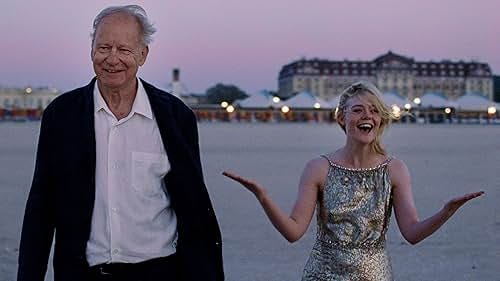
Trier seems to always wrench these absurdly good performances out of everyone he casts and Fanning is no exception. In his New Yorker profile, they comment on his obsession with the psychology of people:
It helps, as Helle [Trier’s wife] told me, that Trier is “endlessly fascinated” by other people’s psychology—“penetrating the top layer of big emotions and trying to understand why people are like they are. That is a constant conversation, at home and with our friends.”
To me, this is what I get a ticket for. Trier makes this angsty, soft-psychological drama. The emotions are rarely big but they’re deep and vast.
And the films are rife with this kind of yearning.
I’ll be honest, Aksel’s death sequence in Worst Person fucked me up for weeks after I saw it3. The raw pain, the plainness of the explanation, the way he divulges these memories not of family or of friends but of things. All in relation to art he’s experienced. How that becomes memory itself.
And, ultimately, the pain of seeing that world go away and get replaced by a new one where you and your ideas are not actually that useful or interesting, as if they ever were.
To me, something characteristic of the millennial age was the use of insincerity as a value. But the bristles, as characterized by Trier’s work, have softened into something often melancholic but also acceptable.
Sentimental Value is more workmanlike in the way it plays on you. It’s spare in comparison to Worst Person, but not diluted. More reduced (in the cooking sense). It knows its job is to give you the powerful emotions and it does.
This wiki page has one of my favourite summations of a film, written by Roger Ebert: “[…] a movie so violent and cruel that most people will find it unwatchable”. He’s correct.
Even the house in this movie, around which the plot takes place, takes on this characteristic. In his New Yorker profile, Trier says of the house: “It had this vibe of the family having come from old money, but then the people who lived in it later being more cultural types, with interesting curiosities,” Trier said. “It had a melancholic feeling of a grand past.”
This is in no small part also due to Anders Danielsen Lie’s performance. Obviously I think it’s a phenomenal piece of writing, but Lie is really excellent. And he’s a doctor when he isn’t acting. Or rather he acts when he isn’t busy being a doctor.