

Disgrace
JM Coetzee's prescient novel about a horrible guy

I’m once again AFK this week, dealing with my problems through the opposite of putting dogs down: eating and indulging myself in a foreign country.
So another Old thing I gone done and did. If you missed last week, I embarassed myself obsessing over a Netflix program (lol). This week, one of our great novels.
Things I gone done and read
Disgrace (1999)
JM Coetzee
Let’s get some things out of the way so you can read this in the proper context: I think this is one of the best books ever written. And yes, I think I probably stumbled across it by pure chance when googling most disturbing books ever written.
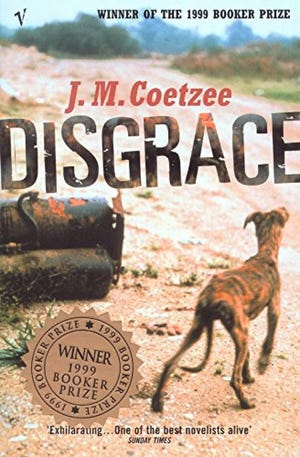
And much can be said about the disturbing content of the book: set in post-Apartheid South Africa, David Lurie, a communications professor (our protagonist no less, the man in whose head we are stuck), has an affair with a much younger woman that crosses the line from dalliance to harassment to straight up sexual assault. When he’s dismissed from his position for refusing to apologize for his actions, he moves to the Cape with his daughter, Lucy. Lucy lives on a farm and boards dogs. There, while taking a respite in the pastoral, they are attacked, robbed, Lucy is raped, and David is set on fire.
Where does one go from here? Well, Lucy, as can be expected, has a particularly hard time dealing with the aftermath. David, whose relationship with his daughter is strained at best, has a hard time dealing with her retreat. And to kill time he volunteers in a veterinary clinic.
Yes, it’s a novel that hearkens back to a time when men dealt with their cancellation the right way: by putting dogs to sleep.
Disgrace opened up the world of Coetzee for me. My own personal experience of Coetzee is that he is in an echelon separate from many writers that are more mainstream, such as McCarthy or Murakami1. When I peeled back the layers of the contemporary “greats”, here was this author, adorned in all sorts of acclaim for novels that are wholly unique to anything I’d read before. Like McCarthy (pre-Oprah), he’s apparently a famously private person and did not appear to collect either of his Booker Prizes.
I don’t want to sound as if I’m introducing you to Coetzee, I’m only highlighting my own ignorance. When reading backwards from Disgrace, I was playing catch up to a great author who was somewhat before my time.
His talent for writing thoroughly pathetic and sad souls is a thing to behold. While engendering pity, his characters are also written with immense pain. There’s some hidden reserve of incalculable talent that allows such spare prose to communicate such deep, soulful suffering. That’s the secret sauce, I suppose.
Disgrace is no different. I think, when casting about the internet for people’s opinions (huge mistake), it’s somewhat in vogue to admire works that portray complex, flawed, awful characters while still distancing oneself from their complex and flawed characteristics so that one can cast themselves in their own morally superior light.
While I agree that it’s pointless to write and/or read a book in which a protagonist has no serious flaws (though it still happens), to view them as if detached from any sort of empathy is absurd and moralistic.
David Lurie is a nearly impossible man to empathize with. His actions are disturbing and unethical. Coetzee makes no qualms about showing that Lurie takes advantage of Melanie Isaacs through his own selfish amorality and blames it on his own primal masculine urges. And ultimately he is an awful man subjected to a horrible fate.
But I don’t think it’s unfair to understand Lurie. His obstinate shittiness, his midlife crisis. He warps it to himself to justify his actions but to excise oneself from trying to understand him is to close oneself off from understanding the complexities of the story.
Lurie is experiencing a midlife crisis. I mean, he says it in the first line of the book: he’s solved the problem of sex. Solved through visiting a sex worker named Soraya. When Soraya abandons him, he seduces Isaacs, his student. His waning power is his own skill at seduction that is quickly wilting as he ages. He obsesses over Melanie’s youth, noticing intensely and uncomfortably how young she is.
It’s easy to read the novel through a modern lens. While it predates #metoo by many years, it’s stunning in how familiar it seems today. The accusation, the media frenzy, and ultimately Lurie’s actions and response. When Lurie’s affair comes crashing down on him and he becomes a pariah at the college, he reacts in a way I think many contrarians (and assholes) wished their favourite rapists and creeps would have reacted: a bald-faced rejection of their own cancellation. But there are no “closed doors” in Disgrace, you ride with Lurie the whole time. He harasses and then assaults Melanie, full stop.
And you’re never afforded a peek inside Melanie’s mind.
This is what can be so hard about grappling with the book. You have to live with this guy and he sucks.
And yet, the scene where he goes before the inquiry is truly electric. He has remorse, he admits what he did, but has absolutely no desire to change. Or rather, he has no desire to change through the mechanisms of the inquiry. He’s so stubborn, so twisted in his principled stance to remain a jerk, it’s almost admirable. His admittance isn’t enough, in his view they need him to beg for forgiveness and he won’t do it. Because, and he’s probably right about this, it will never be enough.
And the scenes that follow are doubly ironic. He resigns in disgrace and instead of being further punished (at first) he is gifted this pastoral beauty where he can go away and write his silly little opera about Byron. It’s like he’s been rewarded for his stubbornness. Congratulations David, you don’t have to protagonate! As in this scene with Lucy when she suggests he volunteer at Bev Shaw’s veterinary clinic:
‘I’m dubious, Lucy. It sounds suspiciously like community service. It sounds like someone trying to make reparation for past misdeeds.’
‘As to your motives, David, I can assure you, the animals at the clinic won’t query them. They won’t ask and they won’t care.’
‘All right, I’ll do it. But only as long as I don’t have to become a better person. I am not prepared to be reformed. I want to go on being myself. I’ll do it on that basis.’
Right? It’s incredible. A damaged man in a damaged world trying desperately to hold onto his own power that will slip away anyway.
Of course, none of this lasts. A man doesn’t assault a woman, refuse to reform, and then get to live out his life on a farm. In fact, it gets a lot worse.
The attack is the central act of the novel. So horrid, so cruel, even to a man like David, it’s enough to begin dissolving the armor he has spent so much of his life constructing. One of the great accomplishments of Coetzee’s prose in Disgrace is that David’s narration always has a touch of disdain about it. Everything is judged, usually quite harshly and the reader can never quite tell what the world is outside of David’s head. Is it his pretentiousness or is it honesty?
When Bill Shaw retrieves David from the hospital, his armor begins to crack. A man who David has thought very little of and basically called his wife, Bev, ugly (despite later cuckolding Bill), when asked why he has done him this favor simply says “You’d do the same.” Oof. Would David do the same? For anyone?
From the attack onward, the novel is concerned with further stripping David of his power.
He has a sense that, inside him, a vital organ has been bruised, abused — perhaps even his heart. For the first time he has a taste of what it will be like to be an old man, tired to the bone, without hopes, without desires, indifferent to the future.
Lucy won’t speak to him about her assault, knowing all too well her father, who believes himself to be unknowable, above it all, will only make things worse. Petrus, Lucy’s ambitious neighbor who wants her land, enlists David to help lay pipes in the ground and David sees he’s nothing more than an assistant, an unacceptable twist of irony that his massive ego cannot handle. Nor can he handle later, when it’s clear that Petrus orchestrated the attack in a scheme to get Lucy to capitulate and give up her land, her independence.
David can’t handle the subjugation.
It’s important here to give a bit of an aside: I don’t have anything but a surface level knowledge of Apartheid or South Africa post-Apartheid.
With Disgrace, in my opinion, being so concerned with power, the loss of it, and subjugation, it’s nigh on impossible to not connect the themes of the book to Apartheid.
However, I’m just ill-equipped to do it. There’s fertile ground there, covered by those much more knowledgeable than me.
For example, I’ve read that it’s implied2 that Melanie Isaacs is black. David takes advantage of her. Soraya, who I believe is directly implied to be Cape Malay, plays out a sort of fake subjugation with David, her being a sex worker and all. When she takes away that facade, it basically ruins David’s life. Well, it sets him on a path to ruin his own life.
I’m echoing this succinct quote from Derek Attridge here:
I need to take on board the fact that because of the intense focalization, combined with Lurie’s self-centeredness, we are excluded entirely from Melanie’s feelings; that Lurie’s dedication to music and animals doesn’t compensate for his inadequate treatment of people; that whatever reconciliation is achieved at the end of the novel, Lurie remains a deeply flawed character, unable to accept the power shift produced by the advent of democracy.
I don’t feel able to comment on this chain of abuse, but there is a lot going on even in these first 30 or so pages.
There’s a line which I’m loathe to include because it’s so chilling to me, but I will, if only to highlight my own lack of ability to unpack the complex history of race relations in South Africa:
Halfway home, Lucy, to his surprise, speaks. ‘It was so personal,’ she says. ‘It was done with such personal hatred. That was what stunned me more than anything. The rest was…expected. But why did they hate me so? I had never set eyes on them.’
He waits for more, but there is no more, for the moment. ‘It was history speaking through them,’ he offers at last. ‘A history of wrong. Think of it that way, if it helps. It may have seemed personal, but it wasn’t. It came down from the ancestors.’
Up until this point, there is a deliberate avoidance by both David and Lucy to call the attack a rape, echoing David’s equivocation earlier in the novel when he assaults Melanie.
But the bit about history and ancestors? It’s simply too much for me to tackle. I only highlight it to reinforce my feelings for the novel: there is so much between the pages of this short book and it’s one of the best ever written, hands down.
Ultimately, David is unable to save his own daughter. “Save”, as if he had the power or emotional capacity to do so. He returns to Cape Town as if trying to find his lost power, a place where can assert himself. A place where he toiled away as an asshole in some sort of obscurity.
Then, in the strangest and most complex of resolutions, he has dinner in George with Melanie’s family. After seeking some sort of resolution on the affair, he endures an awkward evening with them. Melanie’s absence, felt. Afterwards, he earnestly begins work on his Byron opera where, in all of the ironic twists, finds himself shifting the perspective away from Byron and to Teresa.
When he goes to watch Melanie’s play, it’s difficult as a reader to believe what’s happening: David’s introspection, his growth, is almost admirable, almost forgettable are his misdeeds. He seems to have actually changed, despite his firm opposition to doing so.
And then, another downfall. His revelations about the self a false victory.
He returns to Lucy, now certainly pregnant through the assault, clearly orchestrated by Petrus and partially carried out by his relative Pollux, who may be developmentally disabled.
When David catches Pollux spying on Lucy, their confrontation is as disconcerting as any passage in the book. The way he sics the bulldog on the young man, Pollux’s own mental impairment, the embarrassment of Lucy’s nudity.
And finally, a confrontation with Lucy:
‘David, I can’t run my life according to whether or not you like what I do. Not any more. You behave as if everything I do is part of the story of your life. You are the main character, I am a minor character who doesn’t make an appearance until halfway through. Well, contrary to what you think, people are not divided into major and minor. I am not minor. I have a life of my own, just as important to me as yours is to you, and in my life I am the one who makes the decisions.’
And after the attack on Pollux, the casting out by Lucy as a man who has any power over her life, David reasserts his desire to remain unchanged.
He goes to live in a refuse dump, playing a banjo, playing his opera in fact. And befriending and caring for a three-legged dog.
But when it comes to confronting the fact that he might care for something more than himself, after much delay, he brings the dog to the clinic to be put down. He’s giving up on the possibility that he could care for something more than himself, at the close of the novel:
Bearing him in his arms like a lamb, he re-enters the surgery. ‘I thought you would save him for another week,’ says Bev Shaw. ‘Are you giving him up?’
‘Yes, I am giving him up.’
When I read other, more experienced readers, authors, or critics’ thoughts on Disgrace, I feel like this tiny circle inside a forever expanding globe of thought. In fact, this roundtable summed up everything I wish I could say about the novel so you could also read that:
Tears. Fury. Avoidance. Each anecdote reveals Disgrace as a work whose signal feat is to destroy critical distance.
A book merely 200 odd pages long provokes this multilayered response that continues to resonate.
And while people try to draw out meaning using trite comparisons to current popular culture and social affairs (or by simply comparing a bad man to Donald Trump, presumably for dopes like me to click links), those works wash away into an ocean of forgotten things while books like Disgrace circle back and endure.
Further reading
These are pieces I drew from and/or directly quoted and are worth exploring:
This isn’t a condemnation of any of these authors, I’d just argue that Coetzee is not exactly the first author one works through when catching up on literature’s giants. While apparently Age of Iron is often taught in schools, I’d never even heard of it before I read Disgrace.
I disagree with this actually, not that she’s black, but that it’s implied at all. Perhaps I’m missing that part but it seems to me, if anything, you’re meant to infer it. But it’s not implied or directly said anywhere.